Digital Business Card vs. Paper Business Card: Which Is Better in 2026?
05/27/2026
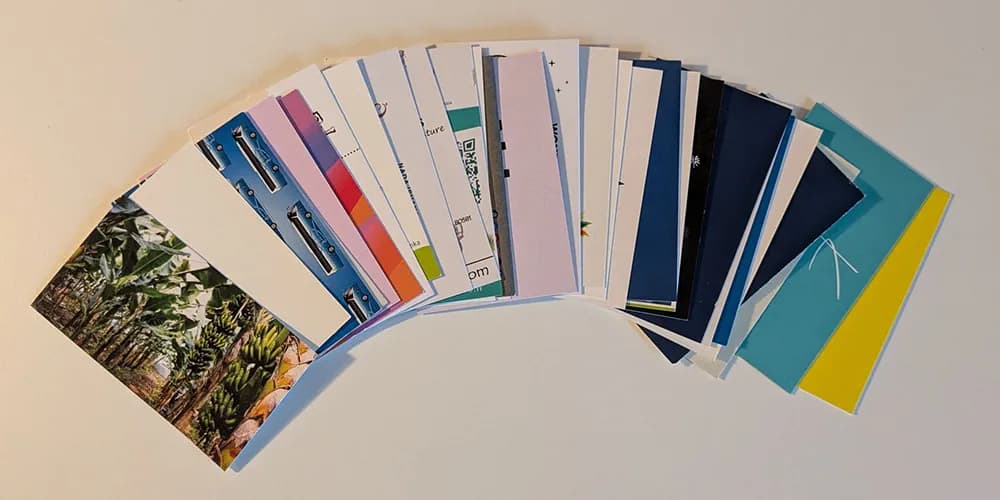
Every year, tens of billions of paper business cards are printed worldwide. And usually within a week a vast majority of them ends up in the bin.
We are not taking a shot at paper cards. The problem is that often the timing is rarely right when someone receives a card. And when it isn't, the card doesn't stand a chance against a full inbox, a busy week, and a jacket pocket that gets emptied on a Friday night.
In 2026, professionals face an interesting dilemma. Digital business cards have matured from a novelty into a mainstream networking tool, and the gap between the two formats has widened considerably. But paper cards haven't disappeared either; and in certain contexts, they still do something digital cards can't.
This post breaks down both formats honestly, round by round, so you can make the right decision for your situation.
If you want to skip ahead and try a digital card for free, IDQR lets you create one in under three minutes - no app required.
What we are actually comparing
Paper business card: a printed card (typically 85×55mm) which carries your name, role, company, and contact details. A professional staple for over 600 years.
Digital business card: a shareable digital profile with the same core information, plus clickable links, social profiles, a booking calendar, analytics, and more. Shared via QR code, NFC tap, a link in your email signature, or a profile URL. Usually the recipient does not need any app to receive it.
The comparison: six rounds
Round 1: Cost
Paper cards
A standard run of 500 cards costs between 50 EUR and 200 EUR and that cost repeats every time you run out of your cards, change roles, get a new phone number, or update your title. Additionally, hidden costs can add up very quickly: redesign fees when your brand evolves, printing before a conference in haste, wasted paper cards after a job change. For a team of 20 people reprinting once a year, the annual spend may routinely exceed 1000 EUR before accounting for anyone's time.
Digital cards
Most platforms offer a functional free tier. Paid plans typically run 4–15 EUR per month. The key benefit of the digital business card is that there is no reprint costs when your details change: you can update your information once, and the change is instantly reflected everywhere your card has ever been shared. Team plans on platforms like IDQR cost a fraction of equivalent paper print runs, with no additional costs per update and no wasted paper cards.
Verdict
Digital wins. The cost advantage compounds significantly over time, especially for teams and anyone whose details change regularly.
Round 2: Networking effectiveness
Paper cards
Paper cards tend to feel more tangible and memorable, especially if it is high-quality and well-made. In certain sectors and contexts, such as luxury goods, finance, law, senior corporate meetings, that physicality might carry weight.
The problem is, however, what happens after the networking. 88% of paper business cards are thrown away within a week of being received. And it is usually not the fault of a meeting itself, but because timing and context conspire against them. The card gets pocketed, mixed up or forgotten, and eventually cleared out. What is more, the processing of the cards after the events takes up a lot of time and error-prone, which makes it inevitable that you loose important opportunities of generating new contacts.
Digital cards
A digital card lands directly in the recipient's phone. No manual entry, no lost card, no typos in the number. Since the contact is stored neatly and can be searched easily, follow-ups happen at a significantly higher rate. Recipients are much more likely to retain contact information from digital cards than traditional ones. This in turn helps generate more new leads and increase conversions.
A QR code takes under three seconds and works equally well at a conference, on a Zoom call, or at a coffee meeting. Beyond QR codes, IDQR digital business cards can be turned into an email signature, so that networking becomes part of every conversation you have.

Verdict
Digital wins on conversion and follow-up rates. Paper retains an edge in industries where the physical card carries prestige or is part of a ritual of exchange.
Round 3: Ease of sharing
Paper cards
Paper cards require physical presence. Also, running out of the cards or forgetting them during an event is a real risk, and a missed card often means a missed connection. You can't share a paper card in a video call, an email thread, a LinkedIn message, or a WhatsApp conversation. Rain, coffee, and tight pockets are not your friends.
Digital cards
One digital business card can be shared through a variety of channels. For example, it can be shared as a QR code from your phone's Wallet in person. Or you can add it as your email signature. It is also easy to share your card as a profile URL in your LinkedIn bio, Instagram story or any other social media. The same card works across many different contexts, be it in person, remote, or hybrid. And the best part of it is that it stays always up to date.
Such ease of sharing and device integration is often cited as the primary reason why people adopt digital business cards.
Verdict
Digital wins outright. It removes every friction point from the sharing experience.
Round 4: Design and branding
Paper cards
Premium materials, such as thick stock, foil finishes, embossing, letterpress and others, communicate craftsmanship and brand quality in a way screens don't fully replicate. A beautifully designed paper card is a physical brand touchpoint. Such business cards tend to be retained more often as recipients associate quality with value.
However, the limitation is obvious: any update means reprinting the entire batch, while premium finishes push costs significantly higher.
Digital cards
While the design can be customised to a point (e.g. brand colours, logos, photos etc.), digital business cards support dynamic elements impossible on paper: direct call and message buttons, link to a booking calendar, real-time social links. Your card is never out of date and does not require reprinting.
The trade-off is however the absence of a tactile dimension. For certain audiences, this shortcoming plays a big role.
Verdict
Draw. Paper cards win on tactile impact and customization. Digital ones win on flexibility, richness, and the ongoing cost of keeping things current.
Round 5: Analytics and follow-up intelligence
This is the round where the gap becomes decisive and it's worth dwelling on, because it changes the fundamental nature of what a business card is.
Paper cards
Paper cards naturally hold or collect any data. You have no way of knowing whether someone looked you up, saved your number, visited your website, or put the card straight in the bin the moment you left the room.
Digital cards
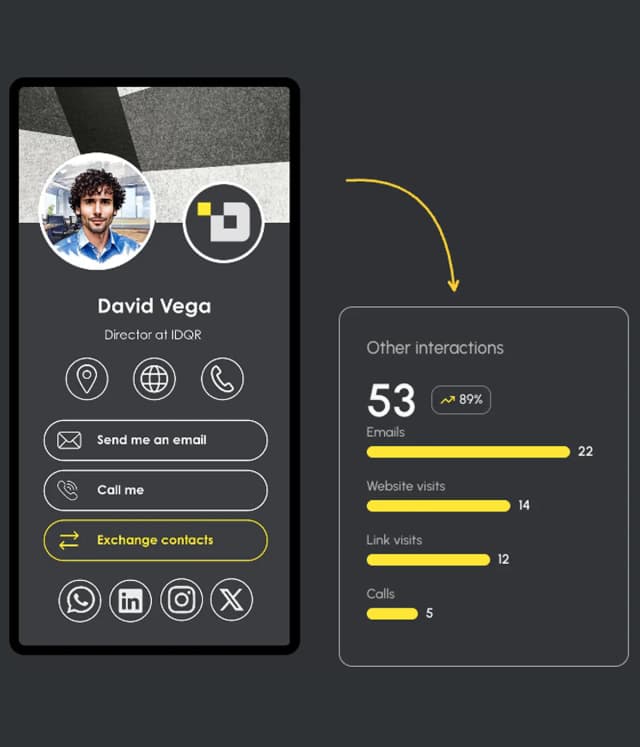
Every profile view, link click, contact save, and social media visit is tracked. You can analyse which events or campaigns drove the most engagement, which links people actually click, and how interest varies over time. IDQR goes further, providing conversion breakdowns, interaction data, and team-wide performance analytics.
In 2026, integrations with CRMs like HubSpot and Salesforce mean that card interactions can feed directly into pipeline tracking. Many professional users now prefer digital business cards with CRM integration for seamless lead tracking.
Verdict
Digital wins completely. Analytics transforms a business card from a branding expense into a revenue-supporting tool. There is no paper equivalent.
Round 6: Environmental impact
Paper cards
Mass-scale paper production is a primary factor contributing to carbon output in the global ecological system. Tens of billions of cards are produced every year. Most end up in landfill, where decomposing paper produces methane, a greenhouse gas significantly more potent than CO₂. For companies with sustainability targets or ESG reporting obligations, the paper card supply chain is a straightforward line item to eliminate.
Digital cards
Digital business cards use zero paper, ink and physical shipping. The server-side energy footprint is much smaller. In general, switching to digital cards results in a significant reduction in paper use.
IDQR's sustainability calculator lets you quantify your team's exact annual savings in CO₂, paper, and water: a useful asset for any company with public environmental commitments.
Verdict
Digital wins decisively. For any organisation with sustainability goals, this consideration alone justifies the switch.
Summary
| Paper cards | Digital cards | |
|---|---|---|
| Cost | Repeating print costs | Low or free, no reprints |
| Networking effectiveness | Tactile, but 88% discarded within a week | Higher follow-up and retention rates |
| Ease of sharing | In person only | Every channel, any device |
| Design and branding | Premium materials, difficult to update | Flexible, rich, instantly updatable |
| Analytics | None | Full view, link, and conversion tracking |
| Environmental impact | Significant paper and landfill waste | 90% reduction in paper use |
When paper cards still make sense
It is important to be honest here. The fact is that paper cards are obviously not dead. However, they’ve become contextual.
There are situations where a physical card still does something a digital one doesn't:
- Luxury and prestige industries: private banking, high-end law, luxury goods - where a premium card signals deliberate investment and cultural fluency.
- Formal cultural contexts: Japan and South Korea in particular, where the physical exchange of cards carries its own etiquette and significance that a phone screen can't replicate.
- Tech-averse recipients: older contacts or settings where reaching for a phone feels awkward or presumptuous.
- Trade show leave-behinds: booth tables where visitors browse physical materials and a card functions more like a printed brochure.
Who should make the switch right now?
- Sales professionals. The analytics and CRM integration make the ROI argument immediate. Knowing who viewed your card and when is genuinely useful pipeline intelligence.
- Freelancers and consultants. Those professionals who do not have rigid rates, services and contact details can benefit from the flexibility of digital business cards. A digital card means you never reprint because you have updated something.
- Startups and SMBs. With digital business cards you can get professional presentation without a printing budget.
- Enterprise teams. One platform, one brand, real-time updates across hundreds of employees. No more outdated cards in circulation, no batch reprints when someone changes roles.
- Anyone attending events or conferences. Sharing a QR from your Wallet is faster, less error-prone, and more memorable than handing over a card. You also benefit from the follow-up data, which is something a paper card can never give.
The verdict
In 2026, digital business cards are the better choice for the overwhelming majority of professionals - on every measurable dimension: cost, follow-up rates, shareability, analytics, and environmental impact.
Paper cards have a legitimate role in luxury and culturally specific contexts. Even then, a digital companion layer adds value without removing the physical experience.
The digital business card market has grown to $238.75 million in 2026, expanding at 12.2% annually, while traditional business card printing volumes have flatlined. The trend is unambiguous.
The question in 2026 is less "should I switch?" and more "what have I been waiting for?"
Create your free IDQR card
Ready to make the switch? Create your IDQR digital business card for free in under three minutes - no app needed to receive it, works on Apple Wallet and Google Wallet, and tracks every interaction from day one.
Create your free card → idqr.app